 |
Operating instructions
|
Instructions for use, warnings and safety instructions for lithium motorcycle batteries
Commissioning
General information:
• �This lithium battery is already activated at the factory and ready for immediate use (if the voltage is sufficient – �we recommend always charging the battery before installation - see point 2).
Always observe the warnings and safety instructions
Always charge the battery before installation
Batteries can lose charge during storage. We therefore recommend fully charging each battery before installation to ensure optimum performance.
General instructions
• �The cranking power at temperatures below 0°C is limited.
•
The maximum operating temperature of the battery is 60°C. Never allow the battery to overheat due to external influences.
•
Check the battery voltage before use. If the battery voltage is less than 12.8 V, recharge the battery (see point 7).
•
Only install this battery in the vehicle in the position specified by the manufacturer. Always ensure that the battery is sufficiently ventilated. Follow the vehicle manufacturer’s instructions.
•
Add these instructions to the vehicle operating instructions.
3.1 Adjustment during installation:
Some lithium batteries are smaller than the original battery. These lithium batteries are supplied with foam elements that can be glued to the sides of the battery to make it the same size as the original battery.
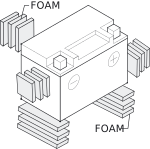
Removing and installing the battery
If you are unsure about removing or installing the battery, please contact a qualified specialist workshop.
Removal:
•
Switch off the engine and all electrical consumers.
•
Expose the battery removal area.
•
First disconnect the negative terminal (-), then the positive terminal (+).
Installation:
•
Expose the installation area of the battery.
•
Avoid short circuits (e.g. using tools).
•
First connect the positive terminal (+), then the negative terminal (-).
•
Ensure that the terminal clamps are firmly and securely attached.
•
Transfer any existing parts (e.g. terminal caps, brackets, hose connections or connection holders) from the old battery to the new one.
Storage and transportation
• �Only store batteries in cool, dry places.
• Protect batteries from direct sunlight.
• For an optimum service life, store the battery with a charge level of 50 to 70% (see Table 1).
• Protect the positive terminal from short circuits (fit terminal cap or insulate with adhesive tape).
• Check the battery charge regularly. Recharge if necessary (see point 7).
Maintenance
•
Keep the battery clean and dry.
•
Only clean the terminals and surface of the battery with a damp anti-static cloth. Otherwise there is a risk of explosion.
•
Tighten the terminals properly.
•
Lithium batteries are maintenance-free. Therefore, never open the battery.
•
If the battery is not used for a longer period of time (e.g. in winter), it is essential to maintain the charge with a charge retention device. Carefully remove the battery before charging.
Charging the battery externally
Important:
If you are not sure how to charge the battery correctly, please contact a qualified workshop.
7.1 Charger
To charge the intAct lithium battery, preferably use a charger with a program for motorcycle lithium batteries. However, it must meet the following requirements:
•
The charging voltage must not exceed 15.0 V.
•
Do not use chargers with an automatic desulphation function.
•
Charge the battery with a current equal to or less than the maximum charging current (specified on the battery label).
7.2 Charging the lithium battery
•
Remove the battery from the vehicle (see point 4).
•
Only use a suitable charger (see section 7.1).
•
Only switch on the charger after the battery has been connected. Once the battery is fully charged, first switch off the charger. Only then disconnect the charger from the battery.
•
Ensure good ventilation when charging in closed rooms.
•
Abort the charging process if the battery heats up.
| Table 1: |
| Voltage (V) |
Capacity |
| 13.340 |
100% |
| 13.300 |
90% |
| 13.270 |
80% |
| 13.160 |
70% |
| 13.130 |
60% |
| 13.116 |
50% |
| 13.104 |
40% |
| 12.996 |
30% |
| 12.866 |
20%
|
| 12.730 |
10% |
| 9.200 |
0% |
Warnings
 |
Instructions
Follow the instructions on the battery, the user manual and the operating instructions of the vehicle concerned. Add these instructions to the vehicle’s operating instructions.
|
 |
Eye protection
Always wear safety goggles when handling the battery.
|
 |
Children
• Keep batteries away from children.
• Keep children away while working on the battery.
|
 |
Fire, flames and smoking are prohibited
• Never place the battery in a fire.
• �Avoid any sparking and electrostatic discharge when handling cables and electrical components.
• �Avoid short circuits (e.g. never place tools on the battery).
|
 |
Risk of explosion
• Short-circuiting, damage, overcharging or excessive heating can lead to overheating, explosion and leakage of the battery.
• �Ensure adequate ventilation and never bring naked flames into the vicinity.
|
 |
Risk of chemical burns
• Lithium is highly reactive and flammable in combination with water (moisture). Avoid any contact.
• �Liquid leaking from the battery (electrolyte) is highly corrosive and can cause severe burns and permanent eye damage.
• �Always wear safety goggles, protective gloves/clothing.
• �Lithium can attack and corrode metals.
|
 |
Handling used batteries
• Hand over used batteries to an authorized disposal company.
• Follow the instructions in section 5 for transportation.
• Never dispose of used batteries in household waste!
|
 |
First aid for lithium batteries
General information: Lithium batteries contain organic electrolytes and lithium salts which can be irritating, corrosive and flammable if leaking, damaged or on fire.
• �In case of inhalation of vapors: Remove affected person to fresh air. If breathing difficulties, coughing or feeling unwell, seek medical advice. If unconscious: place in recovery position, call a doctor.
• �In case of contact with eyes: Remove contact lenses, rinse eye immediately with plenty of water or saline solution for at least 15 minutes. Then seek medical attention immediately.
• �In case of contact with skin or hair: Remove contaminated clothing, rinse affected areas with plenty of water and mild soap. Do not use neutralizing agents.
• �In case of contact with clothing: Rinse with plenty of water or dispose of clothing safely.
• �If swallowed: Rinse mouth, do not induce vomiting, drink some water, contact doctor or poison center immediately. |
 |
�Warning
• Never immerse the battery in water.
• Protect the battery from direct sunlight, as this can damage the battery housing.
• Do not connect the battery to another battery.
• �Do not use the battery if there is an unusual odor, the casing is heated, the casing is discolored or other abnormal symptoms occur. If such symptoms occur during use or charging, remove the battery immediately.
• Never drill, cut or perforate the battery housing.
• Never open the battery. Never solder connections.
|
